India's REIT Moment: How a Quiet Asset Class Became 2026's Real Estate Story
India's REIT market poured more than $2 billion into commercial real estate in Q1 2026 — roughly 40% of all sector capital and the highest quarterly inflow on record. SEBI's equity reclassification, RBI bank lending, and tax reform have together unlocked the next phase of institutional participation.
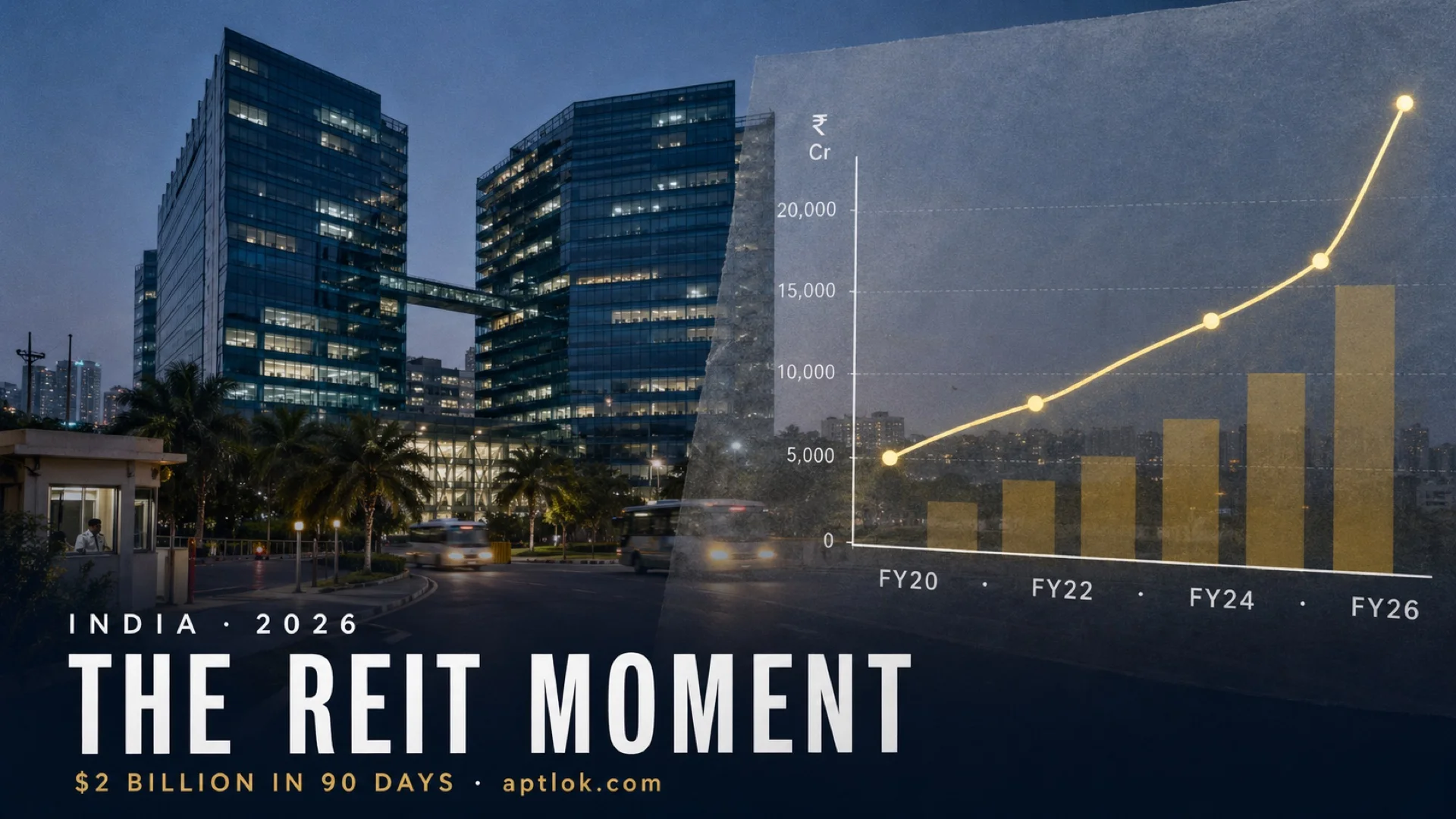
For an instrument that barely existed in India seven years ago, Real Estate Investment Trusts have had a remarkable rise. In the first three months of 2026 alone, REITs poured more than $2 billion into Indian commercial real estate — a multi-fold jump from the previous quarter and roughly 40% of all capital that flowed into the sector during the period, according to CBRE's India Market Monitor Q1 2026. Total real estate inflows hit $5.1 billion for the quarter, a 72% year-on-year jump and the highest quarterly figure ever recorded for Indian real estate.
That headline number is not an accident. It is the result of a structural shift that has been building for years and that finally tipped over in early 2026.
A market that has grown sixfold
When India's first REIT — Embassy Office Parks — listed in 2019, the listed REIT market was worth about ₹271 billion. By the end of the third quarter of FY26, that figure had climbed to ₹1,726 billion, according to CBRE's Real Estate Investment Market Outlook 2026. Five trusts are now listed: Embassy Office Parks, Mindspace Business Parks, Brookfield India Real Estate Trust, Nexus Select Trust, and Knowledge Realty Trust, the most recent entrant, which debuted in August 2025.
Together, these five vehicles manage more than 185 million square feet of Grade A office and retail space across India, with combined gross assets under management exceeding ₹2.5 lakh crore. In the third quarter of FY26, they distributed over ₹2,450 crore to more than 3.8 lakh unitholders, per the Indian REITs Association — taking cumulative payouts since inception past ₹29,000 crore.
The numbers behind the numbers are equally striking. The four older REITs each delivered more than 20% year-on-year growth in unit prices between Q3 FY25 and Q3 FY26. Brookfield improved committed occupancy from 82% at the start of the cycle to 92% by the end of December 2025. Nexus Select, the country's only listed retail REIT, holds 19 malls across 15 cities at 97% occupancy.
Three regulatory shifts that changed the calculus
What turned a steadily growing asset class into a marquee story in 2026 was a cluster of policy decisions that arrived in quick succession.
SEBI reclassified REITs as equity instruments, effective January 1, 2026. The change sounds technical, but it removes a real ceiling on participation. Until now, Indian mutual funds had to slot REITs awkwardly into hybrid or thematic categories, which limited how much exposure large-, multi-, and flexi-cap funds could take. Under the new framework — confirmed by SEBI's circular of November 28, 2025 — REIT units count as equity for the purposes of the Mutual Funds Regulations. Within days of the rule taking effect, fund houses including ICICI Prudential, Aditya Birla Sun Life, Invesco, LIC, and Baroda BNP Paribas updated their scheme documents to reflect the new treatment. Index inclusion is set to begin after July 1, 2026, with AMFI bringing REITs into its market-cap-based scrip classification.
Infrastructure Investment Trusts (InvITs) remain classified as hybrid instruments — a deliberate distinction that recognises their different cash flow profile.
The RBI moved to allow banks to lend directly to REITs. Until this proposal, REITs typically had to access debt through bond markets or structured routes. Direct bank financing reduces the cost of capital and gives sponsors more flexibility to fund acquisitions and refurbishments — a quietly important change for a sector whose valuations are sensitive to borrowing costs.
The Union Budget 2024-25 cut the holding period for long-term capital gains on listed business trusts from 36 months to 12 months, putting REITs and InvITs on the same tax footing as listed equity. The same Budget proposed using REIT structures to monetise assets held by central public sector enterprises — potentially unlocking a fresh pipeline of high-quality buildings for the listed market.
Stack these together and the picture is clear: regulators have spent the past two years removing the artificial frictions that had kept patient institutional capital out of the REIT market.
What a REIT actually is, and why it matters
For all the policy noise, the underlying instrument is simple. A REIT pools money from many investors and uses it to buy commercial real estate — office parks, malls, hotels, warehouses — that generates rent. By law, at least 90% of the trust's net distributable cash flow must be paid out to unitholders, typically every quarter. Investors get exposure to commercial property they could never afford individually, plus the convenience of being able to buy or sell units on an exchange the same way they trade shares.
This is the structural appeal. A 1,000-square-foot office in a Grade A tower in Bengaluru's outer ring road is, in practice, out of reach for most Indian investors. A unit of Embassy or Mindspace, currently trading in the ₹300–500 range, is not. Nexus Select units are even cheaper. Liquidity is the other half of the proposition: traditional real estate takes months to sell, often longer if the title is contested. REITs settle in two days.
For ordinary investors, the closest mental model is a mutual fund focused on income-producing real estate. The yields — typically in the 6–8% range, with some retail-heavy REITs running higher — sit between fixed deposits and equities, with total returns (income plus unit price appreciation) historically running closer to equities.
Where the SM REIT story comes in
Alongside the established trusts, a parallel market is opening up. SEBI's Small and Medium REIT framework, finalised in 2024 and gathering momentum through 2025, is designed for individual assets or small portfolios valued between ₹50 crore and ₹500 crore. The minimum investment is ₹10 lakh — meant for high-net-worth individuals rather than retail — and platforms like PropShare and hBits are leading the early product launches.
CBRE estimates the potential SM REIT market in India at over $60 billion, drawing from more than 300 million square feet of completed commercial office space, with another 50 million square feet expected to come online by 2026. Add logistics and retail, and the total addressable pool exceeds $75 billion. Mumbai alone has more than 75 million square feet of SM REIT–ready completed stock; Delhi-NCR, Bengaluru, and Hyderabad each contribute substantially.
The framework has been deliberately tightened to address concerns that plagued earlier fractional ownership platforms — no investments in under-construction property, mandatory quarterly distributions, and SEBI oversight throughout. If it works as designed, SM REITs will give investors access to the kind of high-quality, smaller-format buildings that the listed market does not touch.
The risks the headlines tend to skip
It is worth keeping the enthusiasm in perspective. REITs are not bonds, and their returns are not guaranteed.
They are equity, with everything that implies. Unit prices move with broader market sentiment. During COVID, Embassy REIT's units fell 20–30% before recovering. The SEBI reclassification only confirms what investors should already understand: REITs behave like equity and should be priced as such.
Income depends on rent, which depends on occupancy. A weak leasing environment, a major tenant exit, or a glut of new supply in a key market can compress distributions quickly. Tenant concentration is a real issue for some REITs — Embassy's top 10 tenants account for roughly 38% of gross annualised rent, and the technology sector alone makes up about 30% of its rent roll. Lease renewals over the next three years will be a critical variable.
Interest rates matter, both ways. When rates rise, REITs face two headwinds: investors rotate toward fixed-income alternatives, and the trusts themselves pay more on their borrowings. The Indian listed REIT market is still heavily tilted toward office assets — close to 133 million square feet of Grade A office space, by Colliers' count — which means the cycle of corporate space demand drives a disproportionate share of returns.
Distributions are mandatory, but only if there are profits. The 90% rule applies to net distributable cash flow. In a year of significant losses or one-off charges, payouts can fall sharply.
The shape of the market ahead
What is most interesting about India's REIT story in 2026 is not any single number but the convergence of conditions. A regulator that has spent two years methodically clearing barriers. A new equity classification that opens the door to billions in mutual fund participation. A bank-lending channel that lowers the cost of expansion. A budget that frames REITs as a tool for asset monetisation rather than a niche capital market product. And a pipeline of new vehicles — including reportedly long-discussed listings from DLF Cyber City Developers and Prestige Group — that could meaningfully expand the universe.
Globally, REITs are a mature, multi-trillion-dollar asset class. The US REIT market alone exceeds $1 trillion in market capitalisation; even Singapore, a fraction of India's size, has a deeper REIT ecosystem. India's listed REIT market, at roughly $20 billion in market value today, has clear room to grow as institutional participation deepens and new categories of assets — data centres, logistics, healthcare, hospitality — find their way into the structure.
For investors who have been priced out of physical real estate, who are tired of waiting months to exit a single property, or who simply want an income stream that is not entirely correlated with their equity holdings, REITs are starting to look less like an experimental instrument and more like a permanent fixture of the Indian portfolio. The question for 2026 is no longer whether the market will mature. It is how fast.
Sources: CBRE India Real Estate Investment Market Outlook 2026; CBRE India Market Monitor Q1 2026; SEBI circular dated 28 November 2025 on REIT reclassification; Indian REITs Association quarterly distribution data; National Stock Exchange data on listed REIT performance; Reserve Bank of India and Union Budget 2024-25 announcements.
About AptLok
AptLok is Hyderabad's real estate intelligence platform — providing data-driven advisory for buyers, investment insights by locality, and digital marketing partnerships for builders. Visit aptlok.com for property listings, locality guides, and market analysis.
Get the Weekly Digest
Hyderabad real estate news, curated every Monday.